
I just finished reading 3 Cups of Tea. It's such a powerful story. No big companies, no governments. Just the work of one guy who saw a human need and wanted to help and to say thank you for being helped. Of course it's grown a bit, so now there is a team of dedicated people. But it's still about local communites and families, wanting something better for their kids and do what ever they can to provide them with some education.
http://www.threecupsoftea.com/
Our schools here in Alaska constantly beg the taxpayers for more & more money. It's always a guilt trip at funding time. Always 'the kids must have ...'. And we struggle to keep our kids in school. So many drop outs. I sometimes think it's too bad that school isn't something to be earned. What's given isn't always appreciated as much as what's earned.
And then there are articles like this one in the Scotsman today.
http://news.scotsman.com/index.cfm?id=1103532007
Can you imagine what it takes to send your kids to school under these conditions. No school building, no books, and facing the potential of being shot, just because they're trying to learn.
Schoolgirls in the gunsights of the Taliban
BARRY BEARAK IN QALAI SAYEDAN
WITH their teacher absent, 10 students were allowed to leave school early. These were the girls the gunmen saw first, 10 easy targets walking hand-in-hand through the blue metal gate and on to the winding dirt road.
A 13-year-old named Shukria was shot in the arm and the back, and teetered into an adjacent wheat field. Zarmina, her 12-year-old sister, ran to her side, listening to the wounded girl's precious breath and trying to help her stand. But Shukria was too heavy to lift and the two gunmen, sitting astride a single motorbike, sped closer.
As Zarmina scurried away, the men took a more studied aim at those they had already shot, finishing off Shukria with bullets to her stomach and heart. Then the attackers seemed to succumb to the frenzy they had begun, forsaking the motorbike and fleeing on foot in a panic, two bobbing heads - one tucked into a helmet, the other swaddled by a handkerchief - vanishing amid the earthen colour of the concealing wheat.
Six girls were shot here on the sunny afternoon last month; two of them died.
The Qalai Sayedan School, considered among the best in the central Afghan province of Logar, reopened only last weekend, but even with Kalashnikov-toting guards at the gate only a quarter of the 1,600 students dared to return. Shootings, beheadings, burnings and bombings are all tools of intimidation used by the Taliban and others to shut down hundreds of schools. To take aim at education is to make war on the government. Parents find themselves with terrible choices.
"It is better for my children to be alive even if it means they must be illiterate," said Sayed Rasul, a father who decided to keep his two daughters at home.
There has been some progress towards development in Afghanistan, but most often the nation seems astride some pitiable rocking horse, with each lurch forward inevitably reversed by the back-spring of harsh reality.
The Ministry of Education claims that 6.2 million children are now enrolled - about half the school-aged population. And while statistics in Afghanistan can be unreliable, there is no doubt that attendance has multiplied far beyond that of any earlier era.
A third of the students are girls, a marvel in itself. Historically, girls' education has been undervalued in Afghan culture. Females were forbidden from school altogether during the Taliban rule.
But after 30 years of war, Afghanistan is a country without normal times to reclaim; in so many ways, it must start from scratch. The accelerating demand for education is mocked by the limited supply. More than half the schools have no buildings, the ministry reports; classes are commonly held in tents or beneath trees or in the brutal, sun-soaked openness. Only 20% of the teachers are even minimally qualified. Texts are outdated; hundreds of titles need to be written, millions of books need to be printed.
And there is the violence. In the southern provinces where the Taliban are most aggressively combating US and Nato troops, education has virtually come to a halt in large swathes of the contested terrain. In other areas, attacks against schools are sporadic, unpredictable and perplexing. By the ministry's rough count, there have been 444 attacks since last August. Some were simple thefts. Some were audacious murders.
"By attacking schools, the terrorists want to turn the people against the government by showing that it has not provided for security," said Haneef Atmar, the minister of education.
Atmar is the nation's fifth education minister in five-and-a-half years, but only the first to command the solid enthusiasm of international donors. He came to the job after a praiseworthy showing as the minister of rural redevelopment and has laid out an ambitious five-year plan for school construction, teacher training and a modernised curriculum. He is also championing a parallel track of madrassas, or religious schools; students would focus on Islamic studies, while also pursuing science, maths and the arts.
To succeed, the minister must be a magnet for foreign cash. And donors have not been unusually generous when it comes to schools. Since the fall of the Taliban, the US Agency for International Development has devoted only 5% of its Afghanistan budget to education, compared with 30% for roads and 14% for power.
Virtually every Afghan school is a sketchbook of extraordinary destitution. "I have 68 girls in this tent," said Nafisa Wardak, a primary school teacher at the Deh Araban Qaragha School in Kabul. "We're hot. The tent is full of flies. The wind blows sand and rubbish everywhere. If a child gets sick, where can I send her?"
The nation's overwhelming need for walled classrooms makes the murders in Qalai Sayedan all the more tragic.
The school welcomed boys and girls. It was overcrowded, with the 1,600 students attending in two shifts, stuffed into 12 classrooms and a corridor.
But the building itself was exactly that - two stories of concrete with a roof of galvanised steel. Two years ago, Qalai Sayedan was named the top school in the province. Its principal, Bibi Gul, was saluted for excellence and rewarded with a trip to America. But last month's attack caused parents to wonder if the school's stalwart reputation had itself become a source of provocation.
In the embassies of the West, and even within the education ministry in Kabul, the Taliban are commonly discussed as a monolithic adversary. But to the villagers near Qalai Sayedan, with the lives of their children at risk, people see the government's enemies as a varied lot with assorted grievances, assorted tribal connections and assorted masters. Has someone at the school provided great offence, villagers ask. Is the school believed to be un-Islamic? Many blame Bibi Gul, the principal.
"She should not have gone to America without the consultation of the community," said Sayed Abdul Sami, the uncle of Saadia, the other slain student. "And she went to America without a mahram [a male relative], and this is considered improper in Islam."
Off the main highway, 330 feet up the winding dirt road and through the blue metal gate, sits the school. It was built four years ago by the German government.
On Monday, Bibi Gul greeted hundreds of children as they fidgeted in the morning light: "Dear boys and brave girls, thank you for coming. The enemy has done its evil deeds, but we will never allow the doors of this school to close again."
These would be among her final moments as their principal. She had already resigned. "My heart is crying," she said privately. "But I must leave because of everything that people say. They say I received letters warning about the attacks. But that isn't so. And people say I am a foreigner because I went to the United States without a mahram. We were 12 people. I'm 42. I don't need to travel with a mahram."
Shukria, the slain 13-year-old, was a polite girl who reverently studied the Koran. Saadia, the other murdered student, was remarkable in that she was married and 25. She had refused to let age discourage her from finishing an education interrupted by the Taliban years.
A new sign now sits atop the steel roof. The Qalia Sayedan School has been renamed the Martyred Saadia School. Another place will be called Martyred Shukria.
Life as a second class citizen
Although the power of the Taliban has been greatly reduced in Afghanistan since the 2001 US-led invasion, slowly but surely their influence, especially in the tribal south, is returning.
• In Badakshan, all women must get permission from their husbands before being allowed to visit a doctor.
• Women teachers are regularly subjected to beatings and assaults from roaming Taliban gangs.
• Mothers who send their children to school are also targeted by the thugs, who try to intimidate them into keeping their youngsters at home.
• Forced marriages and domestic violence feature regularly in the lives of many women who live in the south and eastern provinces of the country.
• Although more women are working in the media now, they are under constant threat. Shaima Rezayee, a popular MTV-style presenter, was shot dead after receiving death threats in 2006.
This article: http://news.scotsman.com/index.cfm?id=1103532007
Sunday, July 15, 2007


Thursday, July 12, 2007
Caribou - Deadhorse Airport - Prudhoe Bay, AK

About 8 am this morning, a herd of Caribou came down the runway. My camera won't zoom in enough for you to see that they had 4 calves with them.
And here is another picture of Fred & Ethel. I took it last week at home. I really like watching the cranes. They must have nested some place fairly close, but behind Patty's house. They walk out of the back yard, hang out in the front yard for a while, then down the driveway. Then 45 min or so later, they walk back up the driveway and head into the trees behind the house. They're never in any hurry, just out for a stroll.

Monday, July 09, 2007
Micro Finance & kiva.org
I've been reading about NGO's and Micro Finance projects for a while. The idea is to get small amounts of money to really poor people, where it can hopefully do a lot of good. I've also been hearing about kiva.org for a while. It was started by a bunch of 'computer geeks' who run or work at businesses like PayPal, Google, Yahoo, Microsoft, etc. The idea is to let individuals lend money to other individuals, watch what it does and get paid back.
http://www.kiva.org/app.php?page=about
Take a look at their web site. This is certainly much more personal than sending a check to a big relief organization. And the overhead costs are hopefully much lower.
I really like what they're trying to do.
http://www.kiva.org/app.php?page=about
Take a look at their web site. This is certainly much more personal than sending a check to a big relief organization. And the overhead costs are hopefully much lower.
I really like what they're trying to do.
Tuesday, July 03, 2007
Site Plan
My lot slopes down from the road and there is a gully on the lower left side. So we're going to build at the top of the gully. The main portion of the house will have a walk out basement, but when you drive in, it will look like it's all on one level. The basement will hold the cistern and mechanical stuff, but all of the living space will be upstairs. The detached garage will connect to the house with a breezeway, and have an apartment on top which will also have great views out over the top of my house.


Monday, July 02, 2007
Potential Floor Plans
I've been working with David & Allegra (DnA Design) the past couple of months on building plans. We're slowly getting a plan sketched out and we're working on the site plan. I can't get the .pdf files they e-mail me to show up here with out hosting them on another site, and that's a bit too technical for me at the moment. So I went a head and scanned a couple of floor plans into .jpg format. This is about round 3, so we're making some progress.


I hope you can figure out what your looking at. Comments are welcome. The front will be mostly glass to take advantage of the view.

Today we walked around the site for an hour or so. The grass has grown up about chest high, so it's a bit difficult to see what's where. We took Greg Collins with us who's going to do the clearing and put in the driveway. So we talked about the pro's & con's of where to put the driveway but have it pretty well figured out. Greg will work it into his schedule sometime the end of Aug. The plan is to remove a few dead trees, a couple that are still alive but in the wrong places, and clear a lot of the alders. Then stack them up to dry so we can burn them all this winter, once it's snowed a time or 2. That way the part of the lot on which I'm going to build will be cleared and ready to build on next summer.
Sunday, July 01, 2007

Friday, June 29, 2007
Lesser Sandhill Cranes

Fred & Ethel (that's what Patty named them) stopped by for a visit tonight. They live someplace pretty close, and normally visit every morning (around 5 or 5:30 am and boy are they LOUD). But they must have been out for an after dinner stroll. It's really a beautiful evening.


Anyway, I was sitting on the front steps talking on the phone when they walked by, totally unconcerned that I was less than 10 feet away. They messed around at the edge of the woods for a while so I finally went inside, found my camera and took a couple of pictures.
Then they decided to continue their stroll and headed down the driveway.


Thursday, June 21, 2007
Kenai Forest Fire

Well, the summer forest fires are starting. This one is 1200 to 1500 acres and is now into day 3. Patty took these 2 shots about 12:30 AM 6/21. She was a mile or so from her house at the Jones gravel pit. They're a bit dark, but not too bad considering they were taken in the middle of the night.
Check the http://www.adn.com/ web site for some more daytime photos of the fire.

Monday, June 18, 2007
Pine Grosbeak
Here is a picture from a couple of months ago. A male Pine Grosbeak at our bird feeder. They start off a rosy pink color and get darker & darker as it gets closer to breeding season. The females stay brown & gray. We had a small flock of them at the bird feeder every day for a couple of months.


Saturday, June 16, 2007
My Office
I decided I'd better clean all the 'old' pictures off my camera, so here are a few that I've taken the past couple of months.




How do you like my new desk? It's very ergonomic. It can be set as low as 22 inches or as high as 56. I try to remember to stand up for a couple of hours every afternoon. These 12 hour days, spent sitting in front of the computer are really not good for my body.

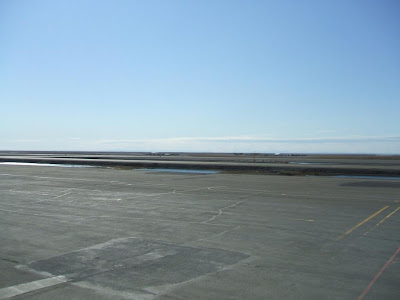
And then here are some pictures I took this morning from my office window. I never get over how FLAT this area is. The 'hills' in the distance are mostly a mirage.

I'm sick of FLAT today, and I want to see the ocean and palm trees. Maybe I'd better change the CD's I've been playing the last couple of days. Lots of Willie K, Ka'au Crater Boys & Jimmy Buffet. Though I am enjoying the sunshine. NO fog at all so far today. But since I have a 4 pm helicopter trip scheduled, I figure it should fog up around 3 pm.

Sunday, June 10, 2007
A Visitor Looking For Lunch
Our Island Repair crew had a visitor for lunch on the 6th. They weren't to excited about this unexpected guest, since he was looking at them as his lunch.
Thanks to Dave for the picture.

Thanks to Dave for the picture.

Saturday, June 09, 2007
Kitchens
My newest adventure is trying to design a house. I've been looking a 100's of house plans and pictures. It's over whelming in many ways.
Here are 2 very different kitchens, but I can see making both of them work with a few tweaks. I like the light wood and will probably go with a Maple cabinets. There's a lot I like about the flat kitchen island with the attached table. And there is a lot I like about the taller bar/island (though not the country look).
Hmm, and any backslpash will need to be in blues & greens, not red & orange :-)


Any comments or suggestions?
Wednesday, May 16, 2007
Arctic Ice
Here is an interesting article from the LA Times. If you want to see the pictures, check their website. I was on R&R when the submarine accident happened, but I know Mark was the ERA Captain who flew the rescue flight for the injured sailor.
I do like some of the descriptions about the ice and how flying above it you can't even tell where the land ends and the sea ice begins. It's much the same driving, you can get out on an ice road and not know where land ends and the sea ice begins pretty easily, until you feel the ice moving a bit beneath you.
And this comment is very true: "Large cold area around the North Pole." It sums up the totality of what most people know about the place.
COLUMN ONE
3 days of minus 20 on an Arctic ice floe
At a temporary military camp on a mile-wide ice slab in the Arctic, life can be numbingly hard -- and death can come with surprising ease.
By Tomas Alex Tizon, Times Staff WriterMay 16, 2007
Beaufort Sea, Arctic Ocean — FOR three days in March I camped on a drifting slab of ice, 200 miles north of Alaska, as close as I'd ever get to the top of the world and to knowing what it would be like to live on an ice cube.
The cold crept through my boots and socks, into my toes and up my legs. It numbed my fingers and face and froze the moisture in my eyes. It swept into my lungs.
My shelter was a plywood shack, which I shared with five men whom I seldom saw. Beneath us, under the ice, the ocean plunged 12,000 feet deep. One of my shackmates, as a way of warning, described what happened to a snowmobile that had broken through the ice. It sank, like a toy whirling through space, all the way to the sea bottom, where it presumably will rest in frigid darkness for eternity.
The message: Watch your step.
"You slip under, you're gone," said Lt. Cmdr. Gerard DeMers, the safety officer at the camp, which was built and run by the U.S. Navy.
To get there, I flew to Anchorage and took a puddle-jumper over the Brooks Range to Deadhorse on the outer edge of Alaska's North Slope. I met up with Times photographer Myung Chun, and we joined a couple of Navy officers on a Cessna to the Beaufort Sea. Leaving Deadhorse was like jumping off a cliff. We left behind every electronic tether — cellphone, Internet, television.
"No HBO," one of the Navy guys said, smirking.
Yet the severing was very undramatic from the air. I could barely discern where Alaska ended and the Arctic Ocean began. Both land and sea were covered with ice.
The Arctic is one of the planet's least traveled regions, and my first glimpses at 3,500 feet gave a hint why. There's a lot of nothing here, a place where empty sky meets with endless ice. In moments the horizon seems to disappear altogether.
The Arctic is the smallest and least-understood ocean, about 1 1/2 times the size of the United States, most of it covered by ice year-round. When viewed on a circumpolar map, it looks roughly circular, with its bull's-eye being the Geographic North Pole — the northern end of Earth's axis.
The Arctic Region usually refers to the ocean and surrounding land masses — including parts of eight nations — above the Arctic Circle, an imaginary line that marks the latitude (66 degrees, 32 minutes north) above which periods of continuous daylight or darkness last up to six months.
Land of the midnight sun in summer and endless night in winter.
The online encyclopedia MSN Encarta had my favorite definition of the Arctic: "Large cold area around the North Pole." It sums up the totality of what most people know about the place. That and the fact that global warming is melting the Arctic's ice cover.
We'd been in the air 1 1/2 hours when the ice camp appeared in the distance like tiny dots in snow. As we approached, it looked more like toy blocks haphazardly thrown together in the middle of an immense hockey rink.
Our Cessna glided onto a runway on the ice, a smooth landing, like any other on solid ground. What hit hard was stepping out. The cold was dry, invasive, a cool burn. I could feel the first breath enter my nasal passage, instantly freezing the hairs and mucus membrane and rushing into my lungs like an announcement: "Welcome to the Arctic!"
The temperature dips to minus 90 in some parts of the Arctic. For most of my time here, it hovered at minus 20, with an occasional wind gust subtracting another 20 to 25.
We were 100 yards from camp. As we tramped across the ice, I silently thanked our handlers for forcing us to wear three layers of everything, every garment Arctic-grade. Then I noticed the sound. Every few steps, it seemed, the thump of my boots hitting the ice resonated like a drum.
"How thick is the ice here?" I asked the man leading us to camp.
He nodded, clearly unable to hear me through his ski cap and parka. "It sounds hollow," I half-shouted. He nodded again.
THE man was Barry Campbell, a 22-year veteran of the Navy's Arctic Submarine Laboratory, a largely civilian detachment based in San Diego, devoted to submarine operations in the Arctic Ocean. A stocky, squinty-eyed man with a grizzled beard, Campbell was the officer in charge at the camp. He promptly led us to the heart and soul of the place: the mess hall, a shack attached to an oversized canvas tent where two cooks prepared and served meals. Once inside, Campbell provided camp logistics.
Population of the camp tonight: 37. The number changed as personnel — scientists, engineers and technicians — came and went on twice-daily flights. Our location: an ice floe about a mile wide, roughly circular, and ranging in thickness from 3 to 8 feet. Picture a giant dinner plate floating on the water. The floe was drifting westward at a rate of a quarter- to a half-mile a day, fast as floes go but not detectable except by measuring instruments.
Then Campbell went over the do's and don'ts of camp. Don't venture outside of camp. Don't travel alone. Don't go into unauthorized areas unless authorized.
Do watch every step. There had been a close call a few days earlier; a worker fell through the ice chest-deep before someone pulled him out. Do eat three meals a day (the body burns up to 5,000 calories daily to stay warm). Do look out the peephole before opening the door to go outside.
"Make sure there's nothing out there that will eat you," he said. A bear and cub had been sighted about 100 miles from camp. "Polar bears do eat people." Other than that, enjoy your stay, Campbell said, adding drolly:
"Every room comes with an ocean view."
The Navy, every few years, builds a temporary ice camp like this one to run submarine war games. When the games end a month or so later, the Navy removes the equipment and burns the camp. Every camp is built in a different spot.
This year the Navy had invited Chun and me, along with Alaska Public Radio Network reporter Annie Feidt, to visit, hoping for friendly publicity. We were largely left to wander around on our own. In the end we saw more than the Navy wanted.
That first afternoon, I explored the camp. The sun, low on the horizon, shone brightly on this odd assemblage of buildings. The camp was about half the size of a football field, its boundaries unmarked, the horizon a faraway uniform line in every direction.
In the middle of camp, someone had stuck a pole in the ice with an arrow pointing to a spot beyond the horizon. Scribbled on the arrow: "North Pole 1016.4 miles."
People scurried between buildings, parkas hiding their faces. White gusts of breath emitted from under hoods. Everyone seemed to move with purpose.
It was a working camp. The whole place felt somewhat like an equipment yard you'd find in the back of a factory. Scattered around were machines and boxes of miscellaneous supplies, barrels of fuel, rifle cases leaning up against sheds, tubs of ice cream stacked in crooked columns. Most of the perishables were kept outside, a benefit of having the entire outdoors as your freezer.
There were about a dozen main shacks, each stenciled with the name of a Las Vegas hotel. The mess hall was the Bellagio. The divers, whose main job was to repair and retrieve underwater equipment, stayed at Caesars Palace. The command hut, the off-limits headquarters where the Navy coordinated submarine war games, was the MGM Grand.
Behind my shack, the Dunes, was one of two "pee holes," which looked like oversized flower boxes. Inside each was a growing block of frozen urine. Nearby were two primitive outhouses with plastic fold-down seats. One lieutenant, Erik Reynolds, later described his first trip to the outhouse. It was night, with no lights, and minus 40 degrees.
"I went in a man and came out a frightened little girl," Reynolds said.
There was a lot of locker room humor. It was predominantly a man's camp, and the only two women, the cooks, laughed and went along.
On the outskirts, about 75 yards past the perimeter, a couple of oceanography students concerned themselves with another hole, one they had made with a tripod that lowered various gadgets into the ice. One gadget melted ice in a circle.
Over two days, the "kids," as the old-timers called them, had melted through 40 feet of ice. It turned out they had burned through an ice keel, a formation that looked like a stalactite below the surface. Keels grow to almost 200 feet deep.
"This is it. The hole," said Tim McGeehan, gesturing at his creation as if making a formal introduction. It was 2 feet in diameter and emitted a fluorescent, otherworldly blue. It was kind of pretty.
McGeehan and John Bleidorn, both students at the Naval Postgraduate School in Monterey, Calif., spent their days prodding, exploring and dropping devices into the hole and studying sonar images on computer screens. They were attempting, among other things, to measure how ice keels affect ocean currents.
As the sun set about 9 p.m., I retired to the Dunes, where I had the place to myself — for a few minutes. The shack was nothing more than a box with six bunk beds, six sleeping bags and an oil-fired heater. Duct tape sealed the gaps in the plywood, but the cold still found ways to seep in, especially close to the floor. The room was either too cold or — when the heater kicked in — too hot. A freezer one minute, a sauna the next.
For the rest of the night, my bunkmates wordlessly flitted in and out as they traded shifts in the command hut, the door creaking and the floor squeaking every time somebody moved.
THE next morning, a bright orange sun rose between the Sands and Circus Circus. The camp by then was already in high-bustle mode.
After breakfast I got my first lesson in the multiple personalities of ice. What prompted it was that hollow sound my footfall made in some areas — thump, thump, thump. It was unsettling. The fear was I would fall through a thin spot and never be seen again.
"Could that happen?" I asked Randy Ray, the man who had cracked through the ice a few days earlier. Ray was field operations coordinator for the submarine lab. He was a big, bearded man, well over 250 pounds, and hulking with his parka wrapped around him. He'd been out scouting locations for a submarine to surface when he hit a soft spot. He was lucky others were near enough to pull him out.
On this morning Ray and a small group traveled two miles from camp and were waiting for the U.S. submarine Alexandria to surface. The 6,900-ton nuclear submarine was engaged in exercises with the Tireless, a 5,200-ton British nuclear sub. Though largely unseen, Alexandria and Tireless were the twin players around which the camp revolved.
At that moment, Alexandria was about 200 feet directly below us.
"See — " Ray began, lightly stamping the surface. "This ice — it's not homogeneous by any means."
From the air it looked like a single sheet, but in reality it was many pieces, like rubble, as small as granules and large as islands, all packed together, which is why it's called "pack ice." This pack ice shifts and breaks apart, melts and refreezes. It's pushed by ocean currents and scraped and shaped by wind. Large cracks, called leads, create free-floating floes like the one our camp was on.
Sometimes a pan of ice will crash into another one and overlap, creating formations above and below and uneven layers in between. The hollow sound, Ray said, could indeed indicate spaces between ice layers.
I was still pondering that when a voice yelled, "Here she comes!"
Within moments a black tower broke through the ice, like a giant chisel through glass, and rose nearly three stories. It was Alexandria's sail. The position of the sail indicated where the shorter rudder would surface, but the rudder was off target by about 30 yards.
"Oh no," someone groaned.
"Get out, get out! Go, go, go!" yelled Ray, as the rudder broke through in the spot where bags and radio equipment had been placed in a mini-encampment. A few bystanders — including me — stood momentarily frozen in awe. Blocks of ice, 3 feet thick, fell away. We quickly moved to safety as the 25-foot rudder eased the equipment and bags aside, like a whale's gentle nudging.
"I have never seen anything like it," exclaimed Reynolds, arms raised in the air as if praising God or warding off an attack.
"Oh my, oh my, oh my," someone else kept muttering. The Navy later explained that submarine surfacing wasn't a pinpoint science. It could have been worse.
But the worst was still to come.
THE news came later the same day, just as the nightly camp meeting began in the mess hall. Dinner started at 7, and the meeting — usually a rundown of the day's events and the next day's schedule — began promptly at 8. The mood was relaxed and jovial.
Officer in charge Campbell was just commenting on the success of the day's submarine surfacing when lab test director Jeff Gossett, a big gray-bearded man (there were a lot of them in camp), rushed into the mess hall from a side door. His face looked ashen. He told the group there had been an accident on Tireless. There may be casualties. Submerged a few miles from camp, the sub was frantically searching for a spot to surface.
Normally it would take days to plan a surfacing. Pilots scout the terrain for an appropriate span of ice, then a land crew conducts tests and plants sonar devices in the water — in essence prepping the site. Surfacing at night through unknown ice was risky. Doing anything on unknown ice, especially at night, was dangerous. But for the next few hours, camp members broke all sorts of safety rules.
Suddenly there was no talk. Everybody burst silently into motion. The mess hall was turned into an infirmary, the tables and chairs replaced by cots and medical equipment. The pilots began prepping the helicopter. People in the command hut worked frantically to coordinate what would become a rescue mission.
When word came an hour later that Tireless had surfaced about 1 1/2 miles from the runway, Campbell approached divers Kevin Parkhurst and Pat McKeown.
"We need you to take the snow machines out," Campbell told them. Tireless needed help fast, and landing a helicopter in that area, where the ice was thought to be thin, would be too dangerous.
Parkhurst and McKeown, after some moments of questioning silence, suited up, started the snowmobiles and drove off toward the runway, the lights on their snowmobiles marking their path to the stricken sub. It was a long, perilous ride in darkness through tracks of ice they had never traversed before.
"We didn't know how serious it was until we got there and they told us there were two deceased," Parkhurst later said.
Apparently an oxygen canister — used to generate breathable air — had exploded in one of the sub's forward decks, killing two sailors and seriously wounding a third. No one was prepared to say what caused the blast; the investigation is ongoing.
The injured sailor was placed on an inflatable raft, which was pulled like a sled back to the ice camp. A helicopter flew him to Deadhorse, and from there National Guard pilots rushed him to a hospital in Anchorage. The journey from submarine to hospital took about eight hours.
The bodies of the two sailors were brought to the ice camp later that night and put in one of the plywood huts in the middle of the village. They would be flown back to Britain the next morning.
Back in the mess-hall-turned-infirmary, four hours after he had broken the news, Gossett slumped in a chair and sipped a cup of coffee. Sagging circles weighed down his eyes. "In all the years, nothing like this has ever happened," he said softly. I could barely hear him. "You can't prepare for it. Not something like this. You can't."
THAT night, my last in the Arctic, I sneaked out of the Dunes to one of the blackest nights I had ever seen. It was just after 2 a.m. Much of the camp had bedded down exhausted, except for a few solitary figures who flitted between shacks. The ice seemed to give off a glow, as if a light bulb were on underneath.
The sky was deep ebony and the stars shone brightly. Earlier, someone had pointed out that the brightest star wasn't a star but Venus. I scanned for it again and thought I found it but couldn't be certain. It was hard to be certain about anything up here.
Normal rules of observation didn't apply. The Arctic was famous for mirages and inexplicable visions. Optical phenomena, the scientists called them. They gave everything a surreal quality, especially at night. The subzero temperature, the suspension of ice crystals in the air and the peculiar gases in the atmosphere bent light in strange ways.
"The Arctic is not so much a region but a dream," wrote author Robert McGhee in "The Last Imaginary Place."
The next morning, Chun and I packed up and headed out to the airstrip. A few others were flying back too. Just beyond the runway, I could see Tireless' black sail and rudder jutting from the ice. What must it be like inside there right now?
"We don't want you here," Campbell said with a weary grin. Just as he met us when we arrived, he saw us off. "Things happen when you're here."
The flight back to Deadhorse was much like the one to the ice camp: wordless, with nothing to look at but the ice below. It looked different now. It was still flat but no longer featureless.
I could see lines where cracks had formed. There were networks of cracks like arteries. I could see riffles and tiny crests like freeze-frame waves. Even the whiteness had variations, sometimes tinted and diaphanous, other times dense like porcelain.
There was a lot going on down there in all that stillness. That was the lesson, if any, of my three days in the Arctic. More a reminder than a lesson: Where you think there's nothing, there could be everything; when you think you're on solid ground, the ground could give way. The whole picture could change in an instant.
tomas.alex.tizon@latimes.com*On latimes.com
Exclusive video For video of the Arctic camp, including interviews and a narrated photogallery, visit latimes.com/arctic.
To see recent Column One articles,visit latimes.com/columnone
I do like some of the descriptions about the ice and how flying above it you can't even tell where the land ends and the sea ice begins. It's much the same driving, you can get out on an ice road and not know where land ends and the sea ice begins pretty easily, until you feel the ice moving a bit beneath you.
And this comment is very true: "Large cold area around the North Pole." It sums up the totality of what most people know about the place.
COLUMN ONE
3 days of minus 20 on an Arctic ice floe
At a temporary military camp on a mile-wide ice slab in the Arctic, life can be numbingly hard -- and death can come with surprising ease.
By Tomas Alex Tizon, Times Staff WriterMay 16, 2007
Beaufort Sea, Arctic Ocean — FOR three days in March I camped on a drifting slab of ice, 200 miles north of Alaska, as close as I'd ever get to the top of the world and to knowing what it would be like to live on an ice cube.
The cold crept through my boots and socks, into my toes and up my legs. It numbed my fingers and face and froze the moisture in my eyes. It swept into my lungs.
My shelter was a plywood shack, which I shared with five men whom I seldom saw. Beneath us, under the ice, the ocean plunged 12,000 feet deep. One of my shackmates, as a way of warning, described what happened to a snowmobile that had broken through the ice. It sank, like a toy whirling through space, all the way to the sea bottom, where it presumably will rest in frigid darkness for eternity.
The message: Watch your step.
"You slip under, you're gone," said Lt. Cmdr. Gerard DeMers, the safety officer at the camp, which was built and run by the U.S. Navy.
To get there, I flew to Anchorage and took a puddle-jumper over the Brooks Range to Deadhorse on the outer edge of Alaska's North Slope. I met up with Times photographer Myung Chun, and we joined a couple of Navy officers on a Cessna to the Beaufort Sea. Leaving Deadhorse was like jumping off a cliff. We left behind every electronic tether — cellphone, Internet, television.
"No HBO," one of the Navy guys said, smirking.
Yet the severing was very undramatic from the air. I could barely discern where Alaska ended and the Arctic Ocean began. Both land and sea were covered with ice.
The Arctic is one of the planet's least traveled regions, and my first glimpses at 3,500 feet gave a hint why. There's a lot of nothing here, a place where empty sky meets with endless ice. In moments the horizon seems to disappear altogether.
The Arctic is the smallest and least-understood ocean, about 1 1/2 times the size of the United States, most of it covered by ice year-round. When viewed on a circumpolar map, it looks roughly circular, with its bull's-eye being the Geographic North Pole — the northern end of Earth's axis.
The Arctic Region usually refers to the ocean and surrounding land masses — including parts of eight nations — above the Arctic Circle, an imaginary line that marks the latitude (66 degrees, 32 minutes north) above which periods of continuous daylight or darkness last up to six months.
Land of the midnight sun in summer and endless night in winter.
The online encyclopedia MSN Encarta had my favorite definition of the Arctic: "Large cold area around the North Pole." It sums up the totality of what most people know about the place. That and the fact that global warming is melting the Arctic's ice cover.
We'd been in the air 1 1/2 hours when the ice camp appeared in the distance like tiny dots in snow. As we approached, it looked more like toy blocks haphazardly thrown together in the middle of an immense hockey rink.
Our Cessna glided onto a runway on the ice, a smooth landing, like any other on solid ground. What hit hard was stepping out. The cold was dry, invasive, a cool burn. I could feel the first breath enter my nasal passage, instantly freezing the hairs and mucus membrane and rushing into my lungs like an announcement: "Welcome to the Arctic!"
The temperature dips to minus 90 in some parts of the Arctic. For most of my time here, it hovered at minus 20, with an occasional wind gust subtracting another 20 to 25.
We were 100 yards from camp. As we tramped across the ice, I silently thanked our handlers for forcing us to wear three layers of everything, every garment Arctic-grade. Then I noticed the sound. Every few steps, it seemed, the thump of my boots hitting the ice resonated like a drum.
"How thick is the ice here?" I asked the man leading us to camp.
He nodded, clearly unable to hear me through his ski cap and parka. "It sounds hollow," I half-shouted. He nodded again.
THE man was Barry Campbell, a 22-year veteran of the Navy's Arctic Submarine Laboratory, a largely civilian detachment based in San Diego, devoted to submarine operations in the Arctic Ocean. A stocky, squinty-eyed man with a grizzled beard, Campbell was the officer in charge at the camp. He promptly led us to the heart and soul of the place: the mess hall, a shack attached to an oversized canvas tent where two cooks prepared and served meals. Once inside, Campbell provided camp logistics.
Population of the camp tonight: 37. The number changed as personnel — scientists, engineers and technicians — came and went on twice-daily flights. Our location: an ice floe about a mile wide, roughly circular, and ranging in thickness from 3 to 8 feet. Picture a giant dinner plate floating on the water. The floe was drifting westward at a rate of a quarter- to a half-mile a day, fast as floes go but not detectable except by measuring instruments.
Then Campbell went over the do's and don'ts of camp. Don't venture outside of camp. Don't travel alone. Don't go into unauthorized areas unless authorized.
Do watch every step. There had been a close call a few days earlier; a worker fell through the ice chest-deep before someone pulled him out. Do eat three meals a day (the body burns up to 5,000 calories daily to stay warm). Do look out the peephole before opening the door to go outside.
"Make sure there's nothing out there that will eat you," he said. A bear and cub had been sighted about 100 miles from camp. "Polar bears do eat people." Other than that, enjoy your stay, Campbell said, adding drolly:
"Every room comes with an ocean view."
The Navy, every few years, builds a temporary ice camp like this one to run submarine war games. When the games end a month or so later, the Navy removes the equipment and burns the camp. Every camp is built in a different spot.
This year the Navy had invited Chun and me, along with Alaska Public Radio Network reporter Annie Feidt, to visit, hoping for friendly publicity. We were largely left to wander around on our own. In the end we saw more than the Navy wanted.
That first afternoon, I explored the camp. The sun, low on the horizon, shone brightly on this odd assemblage of buildings. The camp was about half the size of a football field, its boundaries unmarked, the horizon a faraway uniform line in every direction.
In the middle of camp, someone had stuck a pole in the ice with an arrow pointing to a spot beyond the horizon. Scribbled on the arrow: "North Pole 1016.4 miles."
People scurried between buildings, parkas hiding their faces. White gusts of breath emitted from under hoods. Everyone seemed to move with purpose.
It was a working camp. The whole place felt somewhat like an equipment yard you'd find in the back of a factory. Scattered around were machines and boxes of miscellaneous supplies, barrels of fuel, rifle cases leaning up against sheds, tubs of ice cream stacked in crooked columns. Most of the perishables were kept outside, a benefit of having the entire outdoors as your freezer.
There were about a dozen main shacks, each stenciled with the name of a Las Vegas hotel. The mess hall was the Bellagio. The divers, whose main job was to repair and retrieve underwater equipment, stayed at Caesars Palace. The command hut, the off-limits headquarters where the Navy coordinated submarine war games, was the MGM Grand.
Behind my shack, the Dunes, was one of two "pee holes," which looked like oversized flower boxes. Inside each was a growing block of frozen urine. Nearby were two primitive outhouses with plastic fold-down seats. One lieutenant, Erik Reynolds, later described his first trip to the outhouse. It was night, with no lights, and minus 40 degrees.
"I went in a man and came out a frightened little girl," Reynolds said.
There was a lot of locker room humor. It was predominantly a man's camp, and the only two women, the cooks, laughed and went along.
On the outskirts, about 75 yards past the perimeter, a couple of oceanography students concerned themselves with another hole, one they had made with a tripod that lowered various gadgets into the ice. One gadget melted ice in a circle.
Over two days, the "kids," as the old-timers called them, had melted through 40 feet of ice. It turned out they had burned through an ice keel, a formation that looked like a stalactite below the surface. Keels grow to almost 200 feet deep.
"This is it. The hole," said Tim McGeehan, gesturing at his creation as if making a formal introduction. It was 2 feet in diameter and emitted a fluorescent, otherworldly blue. It was kind of pretty.
McGeehan and John Bleidorn, both students at the Naval Postgraduate School in Monterey, Calif., spent their days prodding, exploring and dropping devices into the hole and studying sonar images on computer screens. They were attempting, among other things, to measure how ice keels affect ocean currents.
As the sun set about 9 p.m., I retired to the Dunes, where I had the place to myself — for a few minutes. The shack was nothing more than a box with six bunk beds, six sleeping bags and an oil-fired heater. Duct tape sealed the gaps in the plywood, but the cold still found ways to seep in, especially close to the floor. The room was either too cold or — when the heater kicked in — too hot. A freezer one minute, a sauna the next.
For the rest of the night, my bunkmates wordlessly flitted in and out as they traded shifts in the command hut, the door creaking and the floor squeaking every time somebody moved.
THE next morning, a bright orange sun rose between the Sands and Circus Circus. The camp by then was already in high-bustle mode.
After breakfast I got my first lesson in the multiple personalities of ice. What prompted it was that hollow sound my footfall made in some areas — thump, thump, thump. It was unsettling. The fear was I would fall through a thin spot and never be seen again.
"Could that happen?" I asked Randy Ray, the man who had cracked through the ice a few days earlier. Ray was field operations coordinator for the submarine lab. He was a big, bearded man, well over 250 pounds, and hulking with his parka wrapped around him. He'd been out scouting locations for a submarine to surface when he hit a soft spot. He was lucky others were near enough to pull him out.
On this morning Ray and a small group traveled two miles from camp and were waiting for the U.S. submarine Alexandria to surface. The 6,900-ton nuclear submarine was engaged in exercises with the Tireless, a 5,200-ton British nuclear sub. Though largely unseen, Alexandria and Tireless were the twin players around which the camp revolved.
At that moment, Alexandria was about 200 feet directly below us.
"See — " Ray began, lightly stamping the surface. "This ice — it's not homogeneous by any means."
From the air it looked like a single sheet, but in reality it was many pieces, like rubble, as small as granules and large as islands, all packed together, which is why it's called "pack ice." This pack ice shifts and breaks apart, melts and refreezes. It's pushed by ocean currents and scraped and shaped by wind. Large cracks, called leads, create free-floating floes like the one our camp was on.
Sometimes a pan of ice will crash into another one and overlap, creating formations above and below and uneven layers in between. The hollow sound, Ray said, could indeed indicate spaces between ice layers.
I was still pondering that when a voice yelled, "Here she comes!"
Within moments a black tower broke through the ice, like a giant chisel through glass, and rose nearly three stories. It was Alexandria's sail. The position of the sail indicated where the shorter rudder would surface, but the rudder was off target by about 30 yards.
"Oh no," someone groaned.
"Get out, get out! Go, go, go!" yelled Ray, as the rudder broke through in the spot where bags and radio equipment had been placed in a mini-encampment. A few bystanders — including me — stood momentarily frozen in awe. Blocks of ice, 3 feet thick, fell away. We quickly moved to safety as the 25-foot rudder eased the equipment and bags aside, like a whale's gentle nudging.
"I have never seen anything like it," exclaimed Reynolds, arms raised in the air as if praising God or warding off an attack.
"Oh my, oh my, oh my," someone else kept muttering. The Navy later explained that submarine surfacing wasn't a pinpoint science. It could have been worse.
But the worst was still to come.
THE news came later the same day, just as the nightly camp meeting began in the mess hall. Dinner started at 7, and the meeting — usually a rundown of the day's events and the next day's schedule — began promptly at 8. The mood was relaxed and jovial.
Officer in charge Campbell was just commenting on the success of the day's submarine surfacing when lab test director Jeff Gossett, a big gray-bearded man (there were a lot of them in camp), rushed into the mess hall from a side door. His face looked ashen. He told the group there had been an accident on Tireless. There may be casualties. Submerged a few miles from camp, the sub was frantically searching for a spot to surface.
Normally it would take days to plan a surfacing. Pilots scout the terrain for an appropriate span of ice, then a land crew conducts tests and plants sonar devices in the water — in essence prepping the site. Surfacing at night through unknown ice was risky. Doing anything on unknown ice, especially at night, was dangerous. But for the next few hours, camp members broke all sorts of safety rules.
Suddenly there was no talk. Everybody burst silently into motion. The mess hall was turned into an infirmary, the tables and chairs replaced by cots and medical equipment. The pilots began prepping the helicopter. People in the command hut worked frantically to coordinate what would become a rescue mission.
When word came an hour later that Tireless had surfaced about 1 1/2 miles from the runway, Campbell approached divers Kevin Parkhurst and Pat McKeown.
"We need you to take the snow machines out," Campbell told them. Tireless needed help fast, and landing a helicopter in that area, where the ice was thought to be thin, would be too dangerous.
Parkhurst and McKeown, after some moments of questioning silence, suited up, started the snowmobiles and drove off toward the runway, the lights on their snowmobiles marking their path to the stricken sub. It was a long, perilous ride in darkness through tracks of ice they had never traversed before.
"We didn't know how serious it was until we got there and they told us there were two deceased," Parkhurst later said.
Apparently an oxygen canister — used to generate breathable air — had exploded in one of the sub's forward decks, killing two sailors and seriously wounding a third. No one was prepared to say what caused the blast; the investigation is ongoing.
The injured sailor was placed on an inflatable raft, which was pulled like a sled back to the ice camp. A helicopter flew him to Deadhorse, and from there National Guard pilots rushed him to a hospital in Anchorage. The journey from submarine to hospital took about eight hours.
The bodies of the two sailors were brought to the ice camp later that night and put in one of the plywood huts in the middle of the village. They would be flown back to Britain the next morning.
Back in the mess-hall-turned-infirmary, four hours after he had broken the news, Gossett slumped in a chair and sipped a cup of coffee. Sagging circles weighed down his eyes. "In all the years, nothing like this has ever happened," he said softly. I could barely hear him. "You can't prepare for it. Not something like this. You can't."
THAT night, my last in the Arctic, I sneaked out of the Dunes to one of the blackest nights I had ever seen. It was just after 2 a.m. Much of the camp had bedded down exhausted, except for a few solitary figures who flitted between shacks. The ice seemed to give off a glow, as if a light bulb were on underneath.
The sky was deep ebony and the stars shone brightly. Earlier, someone had pointed out that the brightest star wasn't a star but Venus. I scanned for it again and thought I found it but couldn't be certain. It was hard to be certain about anything up here.
Normal rules of observation didn't apply. The Arctic was famous for mirages and inexplicable visions. Optical phenomena, the scientists called them. They gave everything a surreal quality, especially at night. The subzero temperature, the suspension of ice crystals in the air and the peculiar gases in the atmosphere bent light in strange ways.
"The Arctic is not so much a region but a dream," wrote author Robert McGhee in "The Last Imaginary Place."
The next morning, Chun and I packed up and headed out to the airstrip. A few others were flying back too. Just beyond the runway, I could see Tireless' black sail and rudder jutting from the ice. What must it be like inside there right now?
"We don't want you here," Campbell said with a weary grin. Just as he met us when we arrived, he saw us off. "Things happen when you're here."
The flight back to Deadhorse was much like the one to the ice camp: wordless, with nothing to look at but the ice below. It looked different now. It was still flat but no longer featureless.
I could see lines where cracks had formed. There were networks of cracks like arteries. I could see riffles and tiny crests like freeze-frame waves. Even the whiteness had variations, sometimes tinted and diaphanous, other times dense like porcelain.
There was a lot going on down there in all that stillness. That was the lesson, if any, of my three days in the Arctic. More a reminder than a lesson: Where you think there's nothing, there could be everything; when you think you're on solid ground, the ground could give way. The whole picture could change in an instant.
tomas.alex.tizon@latimes.com*On latimes.com
Exclusive video For video of the Arctic camp, including interviews and a narrated photogallery, visit latimes.com/arctic.
To see recent Column One articles,visit latimes.com/columnone
Tuesday, May 08, 2007
Sandhill Cranes
The Sandhill Cranes are back. They're one of my favorite birds and we get quite a few that nest here in Homer. They've been waking me up all week, flying near the house in the early morning, though I don't really mind.
I've been trying the past couple of years to get good pictures of them, but with out much luck. I never seem to get close enough.
Here is a picture I took in 2005. Too bad it was in the evening and a cloudy night.

Thursday, April 19, 2007
Spring (?) in Prudhoe Bay

Hmm, Spring Weather.
What we consider spring weather just depends on where we live. This week we decided Spring had officially started here in Prudhoe Bay. Why? Because we had heavy ice fog 2 days in a row that delayed flights getting into our airport.
Todays weather is a bit windy, winds blowing 35 to 40, but the temp is +20. So at least the snow isn't blowing around too badly.
I'm anxious for green grass but up here, that won't happen until sometime in late June.
Friday, March 23, 2007
NYC March 8 - 12
I flew to NYC on March 8th & met my sister Shari for a couple of day sightseeing trip. The weather was rather cold. -10 on Thursday afternoon when I arrive. It stayed cold on Friday but warmed up to the lower 50's on Sat & Sun.
We had a great time, and I plan to put out a full trip report next week. I left my journal in my car in Anchorage, so don't have it to refer too.
This is a Tiffany stained glass window that was on display at the MET We spend Friday afternoon there, getting out of the cold. They also had an Egyptian Art display that I really liked.


We had a great time, and I plan to put out a full trip report next week. I left my journal in my car in Anchorage, so don't have it to refer too.
However, I wanted to post a few pictures, so here they are:
This is a Tiffany stained glass window that was on display at the MET We spend Friday afternoon there, getting out of the cold. They also had an Egyptian Art display that I really liked.


Monday, March 05, 2007
Turnagain Arm Bore Tide - Saturday March 3rd
 Calm water before the bore tide arrives.
Saturday afternoon around 4:30 pm I was driving from Anchorage to Soldotna, and realized there was a small bore tide traveling up Turnagain Arm. I drive this section of road a lot and see them a couple of times a year. It was a clear & sunny day, so I turned into a pull out just before Girdwood and took a few pictures. The Turnagain Arm Bore Tides are rather interesting. They can be pretty big, in fact some people surf them when they're expected to be large enough. This one though was rather small, and there was a lot of ice on the mud flats.
And here is the bore tide arriving, it really roared as the water moved in, though it wasn't a very big bore tide.

Anway, I got a few nice pictures. If you'd like to see the rest of them, click the link on the right to my photo albums and look for: 7 Turnagain Arm Bore Tide
http://alaska.org/bore-tides.jsp
http://tidal-bore.tripod.com/usa/turnagain.html
http://www.wildnatureimages.com/Surfing%20Boar%20Tide.htm
http://alaska.org/bore-tides.jsp
http://tidal-bore.tripod.com/usa/turnagain.html
http://www.wildnatureimages.com/Surfing%20Boar%20Tide.htm
Sunday, February 25, 2007
Kauai

Well, it's Sunday afternoon and -3 here at work. Wed it was -42 so things have warmed up quite at bit. However nothing like 2 weeks ago when I was on Kauai. I spent 11 days and temps were in the mid 70's to low 80's each day. I don't have a lot to say that I haven't already said on previous trips. We had a really good trip. Kauai is one of my very favorite places, even if the traffic does suck.
Lawai Valley from the first lookout.
I thought I'd just post a few of my favorite photos from this trip and let them say everything that needs to be said :-)
The National Tropical Botanical Gardens Lawai 
A view of the Sleeping Giant from Smith's Tropical Paradise.
Annini Beach looking north.

Dad napping on Anahola beach.
Chuck & Dorie at Ke'e Beach, erosion of the bluff exposes the roots of an Ironwood tree.
And a clear day view from the Kalalau look out.
If you want to see the rest of the photos I took, there is a link on the right side of this blog to my photo albums. Scroll down through all of them to 7 Kauai Trip Feb.
Thursday, February 22, 2007
Mud Volcano Update - The Story Continues
Well the Mud Volcano in Indonesia continues to spew mud. The government is trying to stop it, but according to this latest round of articles, the 'expert's don't think they'll have much luck. Here is a picture from the Standard out of Hong Kong.
http://www.thestandard.com.hk/news_detail.asp?pp_cat=17&art_id=38680&sid=12312817&con_type=1
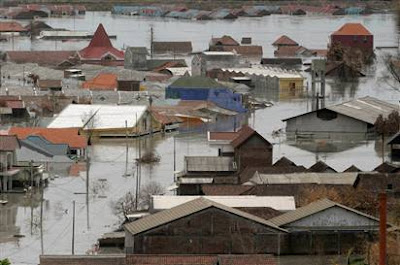
And here is one from MSNBC
The mud eruption that has inundated entire villages since May followed an oil drilling accident in Sidoarjo on the eastern part of Java island.
Numerous efforts to cap the flow have failed and it has become a political and environmental issue, with the government and the drilling company under fire from critics for what they say were lax safety standards behind the accident.
In the latest effort to brake the flow of hot liquid mud, the government today will start to drop 1,500 concrete balls in clusters linked by metal chains and weighing around 400-500 kilograms each into the mouth of the volcano.
"It sounds very difficult right now to stop it," said James Mori, a scientist from the Disaster Prevention Research Institute at Kyoto University. The mud was coming from "a very large crater, so you need a very large structure that can plug that," Mori said Tuesday.
But Rudi Novrianto, a spokesman for the team tasked with stopping the mud, said the plan would proceed.
Two towers were being built to launch the 375 chains of balls into a 50-meter hole from where the mud had been gushing, with each chained cluster consisting of four balls, he said. "We are optimistic that the work will reduce the mud flow," Novrianto said.
 Here is a picture from the Standard out of Hong Kong.
 http://www.thestandard.com.hk/news_detail.asp?pp_cat=17&art_id=38680&sid=12312817&con_type=1

And here is one from MSNBC
They both have the same basic story....see below
Plans to plug a mud volcano that has displaced more than 10,000 people by dropping clusters of concrete balls into it is unlikely to stop the flow, a Japanese scientist said.
The mud eruption that has inundated entire villages since May followed an oil drilling accident in Sidoarjo on the eastern part of Java island.
Numerous efforts to cap the flow have failed and it has become a political and environmental issue, with the government and the drilling company under fire from critics for what they say were lax safety standards behind the accident.
In the latest effort to brake the flow of hot liquid mud, the government today will start to drop 1,500 concrete balls in clusters linked by metal chains and weighing around 400-500 kilograms each into the mouth of the volcano.
"It sounds very difficult right now to stop it," said James Mori, a scientist from the Disaster Prevention Research Institute at Kyoto University. The mud was coming from "a very large crater, so you need a very large structure that can plug that," Mori said Tuesday.
But Rudi Novrianto, a spokesman for the team tasked with stopping the mud, said the plan would proceed.
Two towers were being built to launch the 375 chains of balls into a 50-meter hole from where the mud had been gushing, with each chained cluster consisting of four balls, he said. "We are optimistic that the work will reduce the mud flow," Novrianto said.
Wednesday, February 21, 2007
Pebble Mine
Hmm, to mine or not to mine. This is a huge argument that I'm sure will continue for a LONG time.

Pebble prospect ranks 2nd worldwide
UNPROVEN: A revised estimate of gold, copper deposits puts the value at more than $200 billion.
By ELIZABETH BLUEMINKAnchorage Daily News
Published: February 21, 2007 Last Modified: February 21, 2007 at 02:20 AM
The company exploring the controversial Pebble copper and gold prospect announced Tuesday its Southwest Alaska project now ranks as the second-largest mineral deposit of its kind in the world.
UNPROVEN: A revised estimate of gold, copper deposits puts the value at more than $200 billion.
By ELIZABETH BLUEMINKAnchorage Daily News
Published: February 21, 2007 Last Modified: February 21, 2007 at 02:20 AM
The company exploring the controversial Pebble copper and gold prospect announced Tuesday its Southwest Alaska project now ranks as the second-largest mineral deposit of its kind in the world.
And it's still growing.
The new estimate released Tuesday nearly doubles the copper and gold estimated to lie on state leases within Pebble's eastern area, the richest part of the prospect.
The entire Pebble project, about 19 miles north of Iliamna, is now estimated to contain 82 million ounces of gold and 67 billion pounds of copper.
At today's prices, that's worth more than $200 billion.
Pebble has been a magnet for controversy -- and high-profile advertising and lobbying campaigns -- because the giant mine prospect lies amid streams that feed part of the huge Bristol Bay salmon run and a sport fishing mecca.
Tuesday's announcement is resulting in both fear and rejoicing throughout Alaska.
The president of a Bristol Bay village Native corporation said the doubling of Pebble's eastern deposit -- which lies near several salmon streams -- only makes him more worried.
"With its growth, it just gets scarier and scarier," said Bobby Andrew, president of Aleknagik Natives Limited. But, Tuesday, the executive director of Alaska's Associated General Contractors group called Pebble "the Prudhoe Bay of Alaska mining."
The potential mine could be the state's "next great economic development opportunity," claimed the association's Dick Cattanach, who also co-chairs a group called Truth About Pebble, which is advocating on behalf of the possible mine.
The new estimates of Pebble's mineral wealth resulted from analysis of last year's drilling.
Northern Dynasty Mines Ltd., the Canadian company exploring Pebble, said Alaskans should be cautious about interpreting the new estimates because they haven't been proven yet.
That will take more drilling, and the company still needs to do an economic-feasibility study, Northern Dynasty executives said Tuesday.
The new estimates of the Pebble deposit simply push back the point at which that study is done, said Northern Dynasty spokesman Sean Magee.
He explained that the company, based in Vancouver, British Columbia, will not start looking at the big economic picture at Pebble for at least a couple years.
State officials also stressed Tuesday that Pebble's mineral resources have not yet been proven to be financially worthwhile to develop.
"It gets more real in my mind when there are real dollars assigned to the cost of production," said Tom Crafford, the state's large mines permit coordinator for the Alaska Department of Natural Resources.
Among unknowns for any Pebble developer is where the mine will get the massive amounts of electricity needed to power a huge mine, and how the mined ore would get to the coast for export.
Pebble is arousing significant opposition in Alaska and throughout the United States' sportfishing industry because of its location in the headwaters of several rivers that feed Bristol Bay salmon fisheries -- one of the world's largest single sources of wild salmon.
Both pro- and anti-Pebble groups claim large and growing support bases in Alaska.
In the last two weeks, both sides have staked their positions on a pair of new bills in the state Legislature that would create stricter environmental protection for Bristol Bay's headwaters.
Northern Dynasty executives have decried the new bills. The company also says it won't allow "net loss" of salmon and that it hasn't yet determined the best way to develop Pebble.
The potential mine could involve a small open pit just to the west of an underground mine or the company could decide to develop only an underground mine in Pebble's eastern zone, said Magee, the company spokesman.
According to company's calculations, the only copper and gold project in the world bigger than Pebble is the Grasberg mine in Indonesia. Grasberg has 109 million ounces of gold and 80 billion pounds of copper.
Pebble's mineral resource is still open to expansion to the south and the north, and those areas will be explored this year, Magee said.
Friday, February 02, 2007
Redpolls at our birdfeeder
 The Redpolls have been thick in Homer this winter. Here is a picture I took a couple of weeks ago. They're fun to watch at the bird feeder. The cat likes to watch them too :-)
Well, it's go home day. Blowing snow, about 30 mph of wind. It's supposed to pick up to 40 or 45 so I'm not sure if my plane is going to get in to take me home or not. It left Anchorage so I should know in 1.5 hours. I hope I get out of here on time so I don't miss my flight to Kauai tomorrow.
Sunday, January 28, 2007
Weather Reports
Have you thought much about how relative weather reports are? When I'm headed somewhere on vacation, I start checking the weather to see what I should expect. I'm headed to Kauai next week, and most people looking at this report might be a little bummed. Lots of rain in the forecast these next few days.
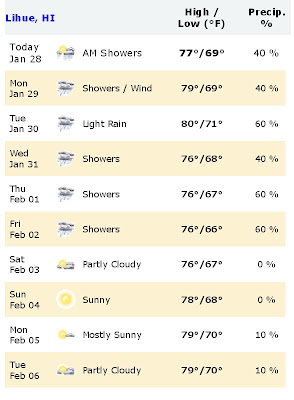 But when you compare it the forecast up here in Prudhoe Bay, even the rain looks good :-)
 Besides, I get into Kauai on Sunday and it's supposed to be a sunny day :-)
But when you compare it the forecast up here in Prudhoe Bay, even the rain looks good :-)Besides, I get into Kauai on Sunday and it's supposed to be a sunny day :-)
Wednesday, January 24, 2007
Indonesian Mud Volcano
I've been following this story since this spring. What a mess, but still it's really interesting. A new study is out so the papers have picked it up.

Here are some pictures and where I got them.
This one is from The Age: http://www.theage.com.au/news/world/drilling-likely-cause-of-java-mud-flow-study/2007/01/24/1169594363110.html

This one is from the Guardian On Line.
http://www.guardian.co.uk/indonesia/Story/0,,1997749,00.html

This one is from AlJazeera
http://english.aljazeera.net/NR/exeres/A405D51D-D403-4893-9FA5-75E5797026C1.htm

http://www.msnbc.msn.com/id/16790691/
Experts tie Indonesia mud disaster to drilling
11,000 were forced from their homes; minister had blamed nature
Updated: 9:43 a.m. HT Jan 24, 2007
JAKARTA, Indonesia - A mud volcano that inundated dozens of villages was probably triggered by commercial gas drilling, research published in a respected scientific journal shows, contradicting an Indonesian government minister who insists it was a natural disaster.
It is "very likely" that the mud flow on the island of Java, which has spewed a million barrels of mud a day for eight months, is manmade, four researchers say in the February issue of the Geological Society of America's GSA Today.
Welfare Minister Aburizal Bakrie — whose family controls the PT Lapindo Brantas drilling company at the center of the scandal — has repeatedly claimed the geyser was sparked by a May 27 earthquake and that his company bears no financial liability.
But the British-based scientists believe drilling at a depth of more than one mile ruptured a highly pressurized pocket of hot gas and water, creating fissures in a bed of porous limestone.
"Once initiated, the fractures would have propagated to the surface, driven by the deep pressure," the report stated. "It would be highly coincidental for an earthquake-induced fracture to form 200 meters away from this well and provide the entire fracture network required for an eruption on the earth's surface."
Since May, around 163,000 cubic yards of sediment — equal to about 50 Olympic swimming pools — has gushed from the site. Around 11,000 people have been forced from their homes while four villages, and 25 factories have been consumed by a 30-foot layer of smelly gunk.
In November, a natural gas pipeline cracked under the weight of a dam built to channel the mud to the sea, triggering a powerful explosion that killed 13 people and injured a dozen others. It took emergency workers several days to find the bodies in the sludge.
The government has said it will seek an initial $420 million in damages from Lapindo, including $276 million paid to the victims, by March 2007.

Here are some pictures and where I got them.
This one is from The Age: http://www.theage.com.au/news/world/drilling-likely-cause-of-java-mud-flow-study/2007/01/24/1169594363110.html

This one is from the Guardian On Line.
http://www.guardian.co.uk/indonesia/Story/0,,1997749,00.html

This one is from AlJazeera
http://english.aljazeera.net/NR/exeres/A405D51D-D403-4893-9FA5-75E5797026C1.htm
And here is on from MSNBC, plus a copy of their story.

http://www.msnbc.msn.com/id/16790691/
Experts tie Indonesia mud disaster to drilling
11,000 were forced from their homes; minister had blamed nature
Updated: 9:43 a.m. HT Jan 24, 2007
JAKARTA, Indonesia - A mud volcano that inundated dozens of villages was probably triggered by commercial gas drilling, research published in a respected scientific journal shows, contradicting an Indonesian government minister who insists it was a natural disaster.
It is "very likely" that the mud flow on the island of Java, which has spewed a million barrels of mud a day for eight months, is manmade, four researchers say in the February issue of the Geological Society of America's GSA Today.
Welfare Minister Aburizal Bakrie — whose family controls the PT Lapindo Brantas drilling company at the center of the scandal — has repeatedly claimed the geyser was sparked by a May 27 earthquake and that his company bears no financial liability.
But the British-based scientists believe drilling at a depth of more than one mile ruptured a highly pressurized pocket of hot gas and water, creating fissures in a bed of porous limestone.
"Once initiated, the fractures would have propagated to the surface, driven by the deep pressure," the report stated. "It would be highly coincidental for an earthquake-induced fracture to form 200 meters away from this well and provide the entire fracture network required for an eruption on the earth's surface."
Since May, around 163,000 cubic yards of sediment — equal to about 50 Olympic swimming pools — has gushed from the site. Around 11,000 people have been forced from their homes while four villages, and 25 factories have been consumed by a 30-foot layer of smelly gunk.
In November, a natural gas pipeline cracked under the weight of a dam built to channel the mud to the sea, triggering a powerful explosion that killed 13 people and injured a dozen others. It took emergency workers several days to find the bodies in the sludge.
The government has said it will seek an initial $420 million in damages from Lapindo, including $276 million paid to the victims, by March 2007.
Saturday, January 20, 2007
Winter at Northstar
I'm back to work for my 2 week hitch and am very ready to get out of here on 2/2/07 and head to Kauai. That's my next planned trip!

In the meantime, here is a picture Mike took from the helicopter today, around 11:45 AM or so. It's still not really daylight up here, just a bit of a sunrise that merges into a sunset. Today was a bit cloudy, so the light isn't very good.
Anyway, this is a picture of Northstar all iced in, and a large lead in the ice that opened up along the north side. It's probably 30 to 40 foot wide. This usually happens in Oct or Nov and should be frozen pretty solid by now. The wind should shift direction tonight so it will probably be squeezed back into a small crack in the ice by tomorrow. It's a good thing that our ice road approaches from the south!
Tuesday, January 02, 2007
Turkmenistan
Saparmurat Niyazov has facinated me the past couple of years. How do leaders of countries get to be so crazy? Why do the people they rule put up with them. I really, really don't get it.
Anyway, he died on 12/21/06. I've been reading a lot of news articles & opinon pieces about him ever since. I don't know what's going to happen in Turkmenistan now, but I hope who ever ends up in charge reinstates health care, hospitals and education.
Here is an article I found today, that illustrates how crazy he was.
Eccentric Turkmenistan president best choice for newsmaker of 2006
Jack Knox, Victoria Times Colonist
Published: Tuesday, January 02, 2007
Forget George Bush. Forget Steve Nash. Forget the guys from YouTube. Forget Paris. Here is the real 2006 Newsmaker Of The Year: Saparmurat Niyazov.
Chances are you never heard of Niyazov. Don't feel bad. Neither has anyone else, at least not outside of Turkmenistan, where the ironfisted despot ruled under the title President For Life prior to that life coming to an abrupt halt just before Christmas.
This is how Niyazov, who also liked to be called "Turkmenbashi the Great, Father of all Turkmen," was eulogized in England's Daily Telegraph: "He renamed a town, a meteor and the month of January after himself, and April (and bread) after his mother. In the rebuilt centre of the country's capital, Ashgabat, he ordered the erection of a huge gilded statue of the 'One and Eternal' leader which rotates to face the sun. . . . He declared a national holiday in honour of melons and another in honour of the horse. He banned gold teeth after watching a student with metal fillings giving an address in his honour, saying it made the country look "backward," and exhorted his fellow countrymen to care for their teeth by gnawing bones instead.
"He banned livestock from the country's capital so as not to overpower the smell of dahlias named after him and slapped prohibitions on (among other things) circuses, ballet, opera, video games, listening to car radios, lip-synching to songs, smoking, newscasters wearing make-up, and beards or long hair on young men."
This, dear reader, is how a true authoritarian is supposed to act -- with authority. None of this benevolent ruler nonsense. None of this father-of-the-people piffle. Niyazov knew how to put the dick in dictator. He has now passed Belarus' Alexander Lukashenko on my Top 10 Tyrants list.
It's more likely you have heard of Lukashenko, often called the last of Europe's Stalinist strongmen. He is seen as a lucky fellow, since his opponents have the odd habit of occasionally disappearing, but is best known in this part of the world as a hockey nut who likes to train with the national team. "You're not allowed to check him," NHL defenceman Ruslan Salei noted a few years ago. "There are guards standing there with guns."
Lukashenko's son, Victor, was similarly passionate about the game, so much so that he reportedly shot Belarus' coach in 1998. "They had an argument about who was going to be named to the national team, and Victor just popped him, right there under the dancing lights of the Max Show discotheque in Minsk," wrote Dave Bidini in CBC Sports Online. The coach lived, but came down with a sudden case of amnesia and was unable to name his assailant.
But I digress. The point is that there's no point to being a despot unless you act with wild unpredictability. Libya's Moammar Ghaddafi surrounded himself with a babacious bodyguard of 40 beautiful women trained in martial arts. Uganda's Idi Amin offered to become king of Scotland. Saddam Hussein liked to fish with hand grenades. Kim Jong Il collected 20,000 videos and once had a South Korean movie star and her director husband kidnapped. But nobody beat Nizayov, whose book of spiritual thoughts -- the Rukhnama -- was required reading in Turkmenistan and even part of its driver's exam.
If I were dictator, the wackiness would rage from Jackuary to Knoxember.
Drive on the left, I would say, and you would -- but only on Tuesdays. There would be a hit-to-pass rule on the Pat Bay Highway, just like at the stock car track. Celine Dion would be banned. Baldness would be mandatory. I would lead the NHL in scoring. Or else.
Crazy? No. Dictators are only crazy in poor countries. In nations with oil and gas, as is the case with Turkmenistan, they are merely deemed eccentric.
Knox is a columnist with the Victoria Times Colonist.
© The StarPhoenix (Saskatoon) 2007
Anyway, he died on 12/21/06. I've been reading a lot of news articles & opinon pieces about him ever since. I don't know what's going to happen in Turkmenistan now, but I hope who ever ends up in charge reinstates health care, hospitals and education.
Here is an article I found today, that illustrates how crazy he was.
Eccentric Turkmenistan president best choice for newsmaker of 2006
Jack Knox, Victoria Times Colonist
Published: Tuesday, January 02, 2007
Forget George Bush. Forget Steve Nash. Forget the guys from YouTube. Forget Paris. Here is the real 2006 Newsmaker Of The Year: Saparmurat Niyazov.
Chances are you never heard of Niyazov. Don't feel bad. Neither has anyone else, at least not outside of Turkmenistan, where the ironfisted despot ruled under the title President For Life prior to that life coming to an abrupt halt just before Christmas.
This is how Niyazov, who also liked to be called "Turkmenbashi the Great, Father of all Turkmen," was eulogized in England's Daily Telegraph: "He renamed a town, a meteor and the month of January after himself, and April (and bread) after his mother. In the rebuilt centre of the country's capital, Ashgabat, he ordered the erection of a huge gilded statue of the 'One and Eternal' leader which rotates to face the sun. . . . He declared a national holiday in honour of melons and another in honour of the horse. He banned gold teeth after watching a student with metal fillings giving an address in his honour, saying it made the country look "backward," and exhorted his fellow countrymen to care for their teeth by gnawing bones instead.
"He banned livestock from the country's capital so as not to overpower the smell of dahlias named after him and slapped prohibitions on (among other things) circuses, ballet, opera, video games, listening to car radios, lip-synching to songs, smoking, newscasters wearing make-up, and beards or long hair on young men."
This, dear reader, is how a true authoritarian is supposed to act -- with authority. None of this benevolent ruler nonsense. None of this father-of-the-people piffle. Niyazov knew how to put the dick in dictator. He has now passed Belarus' Alexander Lukashenko on my Top 10 Tyrants list.
It's more likely you have heard of Lukashenko, often called the last of Europe's Stalinist strongmen. He is seen as a lucky fellow, since his opponents have the odd habit of occasionally disappearing, but is best known in this part of the world as a hockey nut who likes to train with the national team. "You're not allowed to check him," NHL defenceman Ruslan Salei noted a few years ago. "There are guards standing there with guns."
Lukashenko's son, Victor, was similarly passionate about the game, so much so that he reportedly shot Belarus' coach in 1998. "They had an argument about who was going to be named to the national team, and Victor just popped him, right there under the dancing lights of the Max Show discotheque in Minsk," wrote Dave Bidini in CBC Sports Online. The coach lived, but came down with a sudden case of amnesia and was unable to name his assailant.
But I digress. The point is that there's no point to being a despot unless you act with wild unpredictability. Libya's Moammar Ghaddafi surrounded himself with a babacious bodyguard of 40 beautiful women trained in martial arts. Uganda's Idi Amin offered to become king of Scotland. Saddam Hussein liked to fish with hand grenades. Kim Jong Il collected 20,000 videos and once had a South Korean movie star and her director husband kidnapped. But nobody beat Nizayov, whose book of spiritual thoughts -- the Rukhnama -- was required reading in Turkmenistan and even part of its driver's exam.
If I were dictator, the wackiness would rage from Jackuary to Knoxember.
Drive on the left, I would say, and you would -- but only on Tuesdays. There would be a hit-to-pass rule on the Pat Bay Highway, just like at the stock car track. Celine Dion would be banned. Baldness would be mandatory. I would lead the NHL in scoring. Or else.
Crazy? No. Dictators are only crazy in poor countries. In nations with oil and gas, as is the case with Turkmenistan, they are merely deemed eccentric.
Knox is a columnist with the Victoria Times Colonist.
© The StarPhoenix (Saskatoon) 2007
Tuesday, December 26, 2006
Hawaii Superferry
Here is some info on the new Ferry system the state of Hawaii is backing. It's a private company and looks like the first ferry should start to operate in July 2007. There currently is no ferry service in Hawaii, so this will be a first. I hope it works out. It will keep help keep prices down for travel between the island. But the Ferries will also travel over some pretty rough water, lots of sea sick tourists and more tour buses. Yuck.
http://www.hawaiisuperferry.com/index.html
http://www.hawaiisuperferry.com/index.html
Thursday, December 14, 2006
Merry Christmas
Merry Christmas!
Well, here is my annual update. I don’t have a lot to say that’s new, but 2006 has been a pretty good year. Mom & dad are still in Soldotna, so I get to see them a couple of times a month. Patty is here in Homer and has a new job at the Seldovia Tribal Heath Clinic that she really likes. Mary & her family are busy in PA. Matt started college this fall and Katie is about ½ way through her college studies. Shari & Mark are living in DC. Mark is close to retiring from the Army and we’re hoping they’ll be moving back to AK this coming summer. Gio is also a freshman & college so Vince is the only one left in high school.
Shari Gio Mary Vince Mark
I started 2006 out right with a trip to Kauai, still one of my very favorite places. Penny went with me and we stayed at Ed’s B&B. http://www.waterfallbnb.com It was a very relaxing trip. We didn’t feel the need to rush around and see all the sites, so pretty much just hung out and had a good time. We even had great sunny weather. Though not long after we left, Kauai was hit with some of the worst rains in many years and experienced quite a horrible flood & dam break.
 Lori & Penny Napali Trail
In March I bought a 2-acre lot here in Homer. I want to build a house sometime in the next couple of years. I’ve been collecting ideas and pictures. My next step is to find a good architect who can put it all together for me in a house plan.
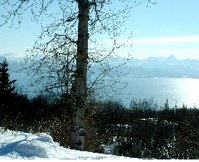 View from my eventual front porch
In April I went to Washington DC and stayed with Shari & and it was washed out before the rains.
Mark for 2 weeks. We also drove to PA and spent a weekend with Mary & Bill. I really had a good time, but I’m glad I went before the weather got too hot. Mom & dad went back east in June (both Matt and Gio graduated from high school). They had a good time but said it was very hot.
We had a very rainy summer here in Homer. I worked a couple of extra weeks, so this past summer seems to have gone by in a flash. I did some painting around Patty’s place but didn’t accomplish much else all summer. I’d planned to do a couple of AK trips, but never got around to them. Next summer I’m definitely going to take a road trip around AK. I’d like to drive the Denali Highway, and maybe even the Dalton. Do any of you want to along?
In October I went to Italy for 17 days with a group of friends. I starting blogging, mostly about trips, so most of you have already seen all the pictures and heard the stories. We had a great time. If you missed out and are interested, here is the address: http://www.loristravel.blogspot.com
Work is work, I’m staying busy and still working 2 weeks on & 2 weeks off. I’m losing interest in trying to go to Russia. The politics over there are a mess. Besides if I’m going to be building a house I need to stay home and get that done, then I’m going to want to live in it instead of taking off right away.
I hope all of you had a wonderful year. I wish you and your families a great 2007. I love to get your Christmas cards and notes, so check in and let me know how you’ve been and what you’ve been up to this past year.
Well, here is my annual update. I don’t have a lot to say that’s new, but 2006 has been a pretty good year. Mom & dad are still in Soldotna, so I get to see them a couple of times a month. Patty is here in Homer and has a new job at the Seldovia Tribal Heath Clinic that she really likes. Mary & her family are busy in PA. Matt started college this fall and Katie is about ½ way through her college studies. Shari & Mark are living in DC. Mark is close to retiring from the Army and we’re hoping they’ll be moving back to AK this coming summer. Gio is also a freshman & college so Vince is the only one left in high school.
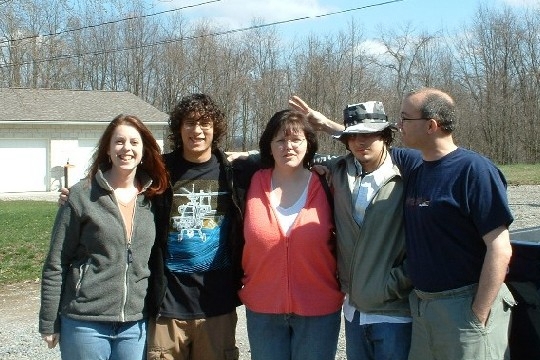
Shari Gio Mary Vince Mark
I started 2006 out right with a trip to Kauai, still one of my very favorite places. Penny went with me and we stayed at Ed’s B&B. http://www.waterfallbnb.com It was a very relaxing trip. We didn’t feel the need to rush around and see all the sites, so pretty much just hung out and had a good time. We even had great sunny weather. Though not long after we left, Kauai was hit with some of the worst rains in many years and experienced quite a horrible flood & dam break.
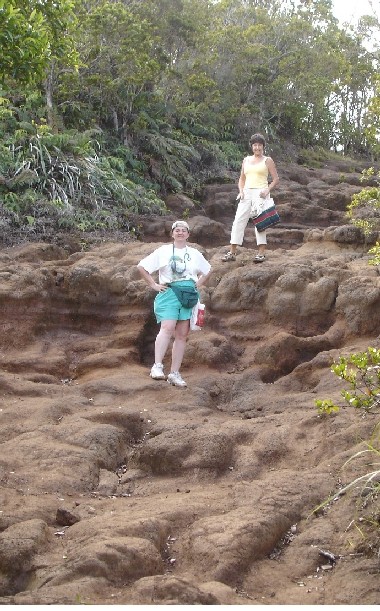 Lori & Penny Napali Trail
 In March I bought a 2-acre lot here in Homer. I want to build a house sometime in the next couple of years. I’ve been collecting ideas and pictures. My next step is to find a good architect who can put it all together for me in a house plan.
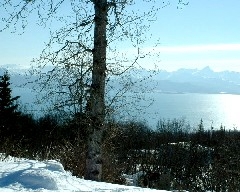 View from my eventual front porch
In April I went to Washington DC and stayed with Shari & and it was washed out before the rains.
Mark for 2 weeks. We also drove to PA and spent a weekend with Mary & Bill. I really had a good time, but I’m glad I went before the weather got too hot. Mom & dad went back east in June (both Matt and Gio graduated from high school). They had a good time but said it was very hot.
We had a very rainy summer here in Homer. I worked a couple of extra weeks, so this past summer seems to have gone by in a flash. I did some painting around Patty’s place but didn’t accomplish much else all summer. I’d planned to do a couple of AK trips, but never got around to them. Next summer I’m definitely going to take a road trip around AK. I’d like to drive the Denali Highway, and maybe even the Dalton. Do any of you want to along?
In October I went to Italy for 17 days with a group of friends. I starting blogging, mostly about trips, so most of you have already seen all the pictures and heard the stories. We had a great time. If you missed out and are interested, here is the address: http://www.loristravel.blogspot.com
Work is work, I’m staying busy and still working 2 weeks on & 2 weeks off. I’m losing interest in trying to go to Russia. The politics over there are a mess. Besides if I’m going to be building a house I need to stay home and get that done, then I’m going to want to live in it instead of taking off right away.
I hope all of you had a wonderful year. I wish you and your families a great 2007. I love to get your Christmas cards and notes, so check in and let me know how you’ve been and what you’ve been up to this past year.
Subscribe to:
Posts (Atom)


 Posts
Posts


